Showing posts with label Learning Hack. Show all posts

Saturday, March 7, 2015

LEARNING HACK; OPEN UP. "MEGA CREATIVITY SHOWS YOU HOW"

Dr. Andrei Aleinikov explains an easy way to improve grades in his book “Mega Creativity”.

He has students sit in a circle around him. They get comfortable, ready for a lecture. He then tells them to freeze.Don't move.

Many students have folded or crossed arms, legs or ankles. He says this is a defensive position and it keeps new knowledge from entering their minds. To get better grades uncross arms, fingers, legs ankles. Be open to new information.

I use this technique not only when attending lectures but also when I am reading. It works.

LISTENING HACK

Dr. Aleinikov also addresses listening. He tells his readers how to listen better in conversations. He says to be aware of speech volume, speed and even pronunciation. When speaking to someone try to match their language style.

MORE

Dr. Aleinikov says that most people just need to make small changes to enjoy more success. He has worked with many individuals. He might suggest a better handshake or better eye contact. Figure out what small change you most need.

Thursday, March 5, 2015

THINGS I WOULDN'T KNOW IF I WAS NOT A READER

Things I wouldn’t Know if I were not a reader.

1. Elfshot, small stones believed by medieval people to be arrowheads shot from fairies. These are believed to protect humans.

2. Tattoos are often used as protective devises.

3. A Crayola will burn for thirty minutes. They make great cheap candles.

4, Tarragon, the spice, is used in magic spells for courage as tarragon means little dragon.

5. The Greeks believed in two kinds of fate. Ananke -just because you are there.Hurricane katrina, ten years ago wiped out whole towns. Everyone was affected. Heimarmene, stuff that happens because of the choices you made. Cynics were a cult who spent their time figure out the two kinds of fate.

6. Dandelions are for courage, also to keep from being evicted. Collect dandelions and place them around the apartment or home.

7. Ben Franklin published “Pamela,” the first novel published in the colonies that would become the U.S. Written by Samuel Richardson, it was originally published in England and reprinted by Franklin in 1744.

8. The Hall of Fame for Great Americans is at Bronx Community College in New York. Inductees have a bust made by a famous sculptor.Edgar Allan Poe’s sculptor was Daniel Chester French, who also sculpted the Lincoln Memorial This was America’s first Hall of Fame. The only non American appears to be General Lafayette,who was granted honorary U.S. citizenship. 9. When Teddy Roosevelt was police commissioner in New York, he took steps to preserve Edgar Allan Poe’s home in New York. The house Poe rented is still there on a land called Poe Park.

10. Gerardus Mercator, a cartographer born in 1512 coined the word “Atlas” after a mythical Titan whom he idolized? Mercator used the word “Atlas” for his collection of world maps.

11. Who gets heart and kidney transplants? One prison inmate received a heart transplant which will probably end up costing taxpayers a million dollars. A death row inmate gets dialysis and has been recommended for a kidney transplant.

12. There are 193 nation members of the United Nations.

A question for the research minded. Could General Lafayette who was, of course, born in France, have become president of the U.S.?

Wednesday, March 4, 2015

WHAT TO DO WITH A POEM

Wednesday is Poems Prayers, Promises Day for our blog. Let’s start with a poem.

There is no frigate like a book

To take us lands away,

Nor any coursers like a page

Of prancing poetry.

This traverse may the poorest take

Without oppress of toll;

How frugal is the chariot

That bears a human soul!

Emily Dickinson.

What can you do with a poem?

Memorize it.

Take it apart and study the words and lines.

Write a response. What do you think of lines like “Prancing poetry”?

Listen to it. Some online sites have a reader reciting the poem.

Learn more about the life of the author.

Find other poems by this author.

Monday, March 2, 2015

SONGS AS MNEMONICS

People in my generation know what year the battle of New Orleans was fought. We simply remember the first line of a Johnny Horton hit song. “In 1814, we took a little trip along with Colonel Jackson down the mighty Mississip.”

Johnny Horton had an entire album of songs about history, “October 1871, that’s when this great big fie begun.” It was easy to learn history from Johnny Horton.

Many years later Tom Lehrer sang about the “Elements.” Hundreds of kids memorized the lyrics and the elements. Gosh that was fun. And while singing along with Lehner or with their friends, kids didn’t even have to use chaining or pegging.

In my record collection, I have an album that includes campaign songs from each president and another album that includes campaign songs from some of the presidential losers. Google songs about history. A huge list will come up.

There are songs about adverbs, adjectives, nouns and even pronouns. On the old "Mickey Mouse Club" television program, Jiminy Cricket sang about the "ENCYCLOPEDIA." He spelled out the letters.

The days of having to buy these albums are over, thanks to Youtube, where you can find most of the songs I mentioned and more.

Sunday, March 1, 2015

LEARNING HACK: PINK NOISE FOR A BETTER NIGHT'S SLEEP

Here is a Sound way to get a better nights sleep.

Insomnia was described by the ancient Greeks as one of the tortures of hell. There are many causes of insomnia and the condition causes problems not only for students, but individuals of all ages all classes and in in all walks of life.

An easy solution to insomnia is “pink noise.” According to a recent article in ”O" magazine pink noise helps shut the mind down and produce sleep. Studies show sleep is deeper and more relaxing with a pink noise background.You tube has several pink noise recordings. I listen to the ten hours of pink noise.

Warning there are commercials. Some people would consider this subliminal advertising. I think the payoff of better sleep is worth a few minutes of commercials that don’t wake me up, and that I don’t remember.

During the day, try “Coffitivity,” coffee shop noises, for increased production.

Go back to You Tube for relaxation music, some of which is designed for study.

It is as easy as it Sounds.

Thursday, February 26, 2015

A DOG HOUSE, A MOUSE AND A BUNCH OF PREPOSITIONS

Yesterday I showed you the PAO (Person, Action, Object) method of creating a pegging list. It is a preferred method of memory competition champs and because everybody’s PAO list is different, it is often well suited to the individual student and less boring than the alphabet.

I will be giving you other pegging lists. But practice with this one for awhile.

As a college English instructor , I found an alternative use for PAO lists. I used it to introduce students to the parts of speech.

In class we followed the steps of yesterday’s blog. We created a list of people, and then a list of transitive verbs (They take an object) and finally a list of nouns that named people places or things.

Put the items in the list together in fun ways and you have a PAO list.

Barack Obama (person) sews (action) coats (object).

Lady Gaga buys cats.

Mickey Mouse chases bumblebees.

The sentences can have some nonsense in them because this makes them easier to remember.

Those objects (coats, cats and bumblebees) are all direct objects. They get their action directly from the verb.

I mentioned yesterday there were two other types of objects.

Indirect Object

I bought my brother a car.

Obviously I didn’t buy my brother. I bought the car. So brother is the indirect object.

I plowed my neighbor’s driveway. Surely I didn’t plow my neighbor. He is the indirect object.

Find the indirect object by rewriting the sentence. If I can put either of the prepositions “for” or “to” in front of the word, that word is an indirect object.

I bought a car for my brother.

I plowed the driveway for my neighbor.

Object of a Preposition

When I was in grade school teachers told us if we could not recognize prepositions, we had to memorize the list in the book. I don’t think any of my classmates memorized the list. We all told ourselves we could recognize a preposition.

As a college instructor I have had students come up to me after class and start reciting the prepositions in alphabetical order. Those were the students who memorized the lists of prepositions. They learned them well, and all these years later were able to rattle off the list of prepositions.

“About, Above, Across, At…” These students could do the entire list.

We had a notetaker in class one day, and I asked her how she recognized prepositions. She shrugged. “I don’t know. I just do,” she said.

I am like that too. I just know a preposition when I see one. Two of my students taught me some easy methods for those who don’t recognize prepositions on sight and who never memorized a list of them.

The dog house rule:

If I can put the word in front of The dog house,” it is a preposition.

A mouse can go under the dog house: the dog can walk to the dog house. I can hang a bird feeder above the dog house.

Other prepositions are into, on in, of, from, for, beneath.

If you try this with a list of prepositions that you find online or in an English book, some may not work. “During” is a preposition, but it does not work with “the dog house.” There are a few others, but the dog house rule limits the prepositions you might have to memorize

Anyplace a Mouse Can Go

Another student told me a preposition is anyplace a mouse can go. Above, over, under, into, on, off, past, onto.

I hope these grammar tips help.

Wednesday, February 25, 2015

PAO - FOR BETTER MEMORY AND GRAMMAR

Memory experts have a type of pegging list called PAO. The letters stand for Person Action Object. Memory champions use PAO like any pegging list be it a list of locations or a list inspired by the alphabet or some other recognized order. I sometimes use the names of the forty-four U.S. presidents as a pegging list. Most people would probably prefer PAO. It is more memorable.

Creating a PAO list is fun and easy. First write a list of people’s names. These can be actors, historical figures, cartoon characters, fictional characters or friends and relatives. Let’s start with ten names.

Persons:

1. Elvis Presley

2. Queen Elizabeth

3. George Washington

4. Eva De Neve (my mother) Substitute the name of your mother, aunt or teacher.

5. Mickey Mouse

6. Snoopy the beagle

7. Barack Obama

8. Justine Bieber

9. Snow White

10. Sleeping Beauty

Actions:

Now make a list of ten transient verbs. These are verbs that take an object.

Kissed, kicked, swallowed, ate, read played, broke, carried, caught, cleaned, drank. paid, stopped, helped.

That is more than ten, but we don’t have to use them all. Feel free to look up more transitive verbs online.

Objects:

Now make a list of nouns that name people or things.

fiddlestick, cow, donkey, dog, drums, book, spaghetti, Bugs Bunny, cat, paycheck, lamp, sofa, door, bedroom, bumblebee.

These are just examples. Use them or your own list.

Now let’s make sentences.

Elvis Presley kissed a cow.

Queen Elizabeth swallowed bumblebees.

Greorge Washington kicked Bugs Bunny.

Go on make your own sentences. Comeback when you are finished.

Finished?

Now memorize the list of PAO’s. Add more than ten if you like. Why? Because we often have more than ten new items to memorize. Memory exercises are great exercises to grow the brain. Also a pegging list can be used to more easily memorize something else.

Say I want to memorize ta few state capitals.

To memorize Montgomery, Alabama I see Elvis Presley kiss a cow while actress Elizabeth Montgomery. I connect the two images in my mind, so I can remember the new material easier.

Also you just got a grammar lesson.

The people in your first list are here being used as sentence subjects. An easy way to determine what the subject of the sentence is, us to ask who or what the sentence is about.

Those action words were all verbs.

The last list is a group of words used here as objects. Nouns usually function in sentences as either subjects or objects. There are three kinds of objects. Object of a preposition, direct object and indirect object.

In the examples given the cow, the bumblebees and Bugs Bunny are direct objects; they get the action right from the verb.

Let’s save the lesson on indirect objects and objects of prepositions for tomorrow or the next day.

Tuesday, February 24, 2015

UNSCHOOLING - HOW ONE STUDENT - ME - MADE IT WORK.

Has unschooling ever worked for any student? It did for me.

I fell in love with American history at a young age. I read books about the American Revolution, westward movement and the presidents. Every week I went to the library and selected two of three books to devour. I read all of Laura Ingalls Wilder’s and Zane Gray’s books. I loved John Dickson Carr, whose mystery stories included locked room puzzles. They were great lessons in critical thinking, not that I knew that then.

Despite my passion for reading, I was not doing well in school. I was a strange kid with stringy brown hair that would not hold the bouffant hair styles so popular then. I wore thrift shop clothes, had cavities in my teeth and just didn’t make friends very well.

On the bus and on the playground, the bullies tormented me. I was ashamed of not having friends to play with, so I tried to hide in the bathroom with a book. The teachers would make me go outside.

I hated the lunches, so the teachers picked on me about that.

I was bored with the lessons. We studied the same things every year. Apostrophes have to be the most boring thing on earth, not to mention comparative and superlative adjectives.

I did poorly in all my subjects except history and English. I did well in history because it didn’t bore me, though the textbooks were not as good as the books I took from the library.

I did well in English because I was a reader. Maybe I didn’t know the comma rules or the nouns and verbs and other rules, but I had seen enough proper sentences in books that I could recognize the correct version. I was like a musician who plays by ear. I read and wrote by ear.

School did take its toll on me. I stopped even trying to study. I retreated into a world of daydreams. I watched television and read books because the fantasy worlds in both fed my daydreams.

But I did not just learn in books.

I joined a humane society and a writers club. These were adult evening activities, so even though I had no friends my own age, I spent time with intelligent mature people who did not repeat the same boring material over and over.

Unschooling will not work for all students. Most students don’t skip school to go to the library like I did. They have little or no interest in history, animal welfare or writing, but there has to be alternatives to public school for those of us who do not thrive there and cannot learn there.

Homeschooling is a great option, but most parents don’t have the resources for homeschooling. It takes time, effort and money.

What other options are there?

The granny cloud works in India, and I will have more about that and other options in future columns.

Monday, February 23, 2015

TELEVISION: LIMITS AND E-LIMITS

Smart schooling often requires tossing out the television. Or at least limiting the hours it is on. There is nothing wrong with television like there is nothing wrong with wine and candy. But a diet rich in any of these items is unhealthy. Television is addictive, and children are easy victims of its lure. We would all do best on a diet of one or two pre-selected programs a week.

When we do watch television,we need to learn from it. That doesn’t mean we select a television diet of documentaries and news programs. If I watch a CSI program, I can take an interest in the science. If I watch the “Tudors” or any historic recreation, I can take an interest in the history.

Are there any old westerns playing this week? The American west is rich in history, science, ecology and geography.

Saturday, February 21, 2015

BOOK REVIEW, HOME GROWN, BY BEN HEWITT

Book Review

Home Grown, Adventures in Parenting Off the Beaten Path and Connecting to the Natural World

Author: Ben Hewitt

224 pages

Ben Hewitt and his wife travel the road less taken. They live on a farm where they grow most of their own food, drive a decades old car, wear second hand clothing and un-school their two sons.

The boys, both of them under ten years old, spend their days helping with the farm work, hunting and trapping. The activities were chosen by them. While they are expected to help with chores like any other youngster, the hunting and trapping is their decision.

The children are not illiterate. They read and studied enough about the hunting and trapping to obtain their licenses.

The children pick their own activities and their own learning schedule. The family does not have television, so reading is a popular evening activity. So is fashioning traps and bows and arrows. The hunting and trapping equipment is all homemade.

Reading, “Home Grown,” Hewitt’s collection of essays about un-schooling his children was an adventure for me. The book came to my attention as I was contemplating the future of mankind in a world where workers may soon not be needed. What kind of a world will that be?

It wasn’t Hewitt’s intention to answer that question, but he did give me something to think about. We need people capable of survival. Some people need to know how to produce their own food. There may come a time when we may again have to depend upon such individuals.

Hewitt butchers his own livestock. He says he does it in a way that does not hurt or frighten the animal. I believe him. Still I am a vegetarian, who recently gave up dairy reading about raising animals to kill them is disturbing to me. If I had a cow, I could not kill her. I would not take her calf away from her, so I can drink her milk.

I have long been anti-trapping and have signed several petitions to end the killing. I see no value in hunting or trapping.

But in some ways I understand that some people in our modern world must have these skills.

I debated, not reviewing this book. I am after all almost vegan.

I can’t kill an animal. I can’t ask anyone else to kill or hurt an animal for me. Yet Hewitt and his children can kill animals humanely. They use every part of the animal. They have skinning and cooking skills that start not with a chunk of meat in the grocery store, but with a dead animal. Hewitt’s young sons can not only kill, but can skin and fry a field mouse.

So momentarily I wanted to diss the book. Then I realized these people live close to the animals that are part of their farm. The children have learned real and perhaps useful skills.

But what else are these children learning?

Un-schooling is hard to define. It is a type of home schooling with fewer rules. The child learns, but on his terms. The Hewitt children as I said learned to read and write while studying hunting and trapping techniques. They even make their own bows, arrows and traps. The traps they make according to the book are humane. There are no steel teeth. Some traps kill the animal instantly.

When we’re talking about school, we are talking about ethical issues, and school does not work for thousands of children.

What about un-schooling? It works for this family whether I like what the children are learning or not. They are learning.

Friday, February 20, 2015

INDUCTIVE AND DEDUCTIVE REASONING; DETECTIVE AND SUSPENSE FILMS

This is how I explained deductive and inductive reasoning to my students..

Deductive reasoning:

Say you are at home watching television. The first show to come on is “McCloud’ or “Starsky and Hutch” or “CSI” Anyway it is a detective show. A crime has been committed. The lead actor or rather lead detective looks at the clues.

He is using deductive reasoning. He starts with a conclusion, the victim. He clearly has been murdered. The detective looks for motives, opportunity, and means. He works from a conclusion backwards looking for evidence to support the conclusion. Detectives use deductive reasoning.

Inductive reasoning

Back to the television. The next program after the detective show is a suspense drama movie. Doris Day or Deana Durbin or some heroine is in danger. She has received poisoned chocolates which the poor dog ate and died. Someone tried to run her over with a car. Someone barely missed her with a rifle shot. She comes to the conclusion that someone is trying to kill her. Her reasoning is much different than that of the detective. She takes close call number one, close call number two and close call number three and decides that she is in danger. She is moving toward a conclusion.

The detective on the first program started with a conclusion and worked backwards. In the suspense drama, the heroine worked toward a conclusion.

Shop Amazon - Get the New Kindle Fire HDX Tablet

Wednesday, February 18, 2015

LEARNING HACK: BE PERSISTENT

In 1955 singer Fats Domino performed in Ottawa, Canada. Before the performance, he was surprised to find a kid in his dressing room. The youngster insisted on performing a song he had written for Fats Domino. The famous performer had no time to listen. Security tossed the kid out of the building.

Somehow the boy made his way back inside. He was tossed out again and again he somehow managed to get back inside. Finally, if only to get rid of the youngster, Domino's manager agreed to listen to a recording that the boy had.

The boy had performed his song on the demo and to Domino's surprise it sounded great. He had his manager contact the boy's father. The fifteen year old persistent lad was offered a recording contract and that demonstration record became the biggest hit of the year.

The boy's name was Paul Anka. He went on to record a string of hit songs for himself and the theme song to the “Tonight” show when Johnny Carson was the host. . Among his most famous tunes was “My Way” which became Frank Sinatra's signature song. We may never have heard of that boy, if he had not been persistent.

It couldn't have been easy getting past security time after time and it would be even more difficult today in our much more dangerous world.

But like Paul Anka, we owe it to ourselves and to the world to try and get our songs heard.

Keep reading, In future columns, I have some suggestions to help you get beyond the gate keepers.

Persistence pays off in school work too. Sometimes you think you will never grasp that math concept or remember that punctuation rule.Keep at it. You'll learn; you'll succeed.

Friday, February 13, 2015

LIFE-LONG LEARNING, BY PATRICK MATHIESON

In this post guest blogger, Patrick Mathieson, answers the question: What is the best way to structure self-education after graduating form college and working full time? This post originally appeared in Quora.

Welcome my first guest blogger.

If you try to set up a comprehensive self-education program all at once, you run the risk of stumbling, missing your ambitious learning goals, and becoming discouraged.

IMO, the better tactic is to develop the habit of learning new things every day. The best way I know to do that is to read constantly. And the best way to read constantly is to always have a book (or books) right next to your bed.

This is what my bedside drawer looks like right now:

When I wake up in the morning, the first thing I do is grab a coffee and pick up a book. When I go to bed at night, the last thing I do is floss -- and then pick up a book. You can see from the above photo that there's not much rhyme or reason to the book selections... just stuff I think is interesting. Every few months I blow a hundred bucks on Amazon and add 7 or 8 titles to my stack.

(Interestingly, you mentioned "neuroscience, mathematics, coding, critical thinking, behavioral economics" in your question details... you might actually enjoy a few of the books you see above.)

I'm sympathetic to the idea that reading materials should be coordinated in an effort to make a "structured self-education" program... but I also recognize that the human brain craves diversity and gets bored easily. Personally, I find it more productive to focus less on what I'm reading, and focus more on reading consistently. If you regularly read books for an hour or two every day (which isn't hard... squeezing in 45 minutes of reading over coffee and breakfast is my favorite part of the day), you can burn through 20 or 30 or 40 books in any given calendar year. That's enough to digest all the seminal works in whichever field you think will help most in your career and still have time for Harry Potter and 50 Shades of Grey.

That said... Quora is a pretty awesome place to learn new things, too. If you can sneak in 30 minutes of Quora-ing in addition to everything I wrote above --- you'll be in good shape. Good luck.

Wednesday, February 11, 2015

LEARNING HACK: TAKE THE SMART BUS

In the the Southeastern Michigan area where I live, we have Smart buses and School buses. The Smart busses are public transformation. School busses, of course, transport students to and from the daily prison we call school.

These busses seem a great analogy for two types of education. There is the school system that has existed in American since Horace Mann advocated disciplinary action and Prussian military school methods in the early 19th century. We have not much changed our model of schooling since then.

Outside of the school system, there are a million ways to learn. I have detailed a few of them here in my blog. There is a growing movement in this country called “unschooling.” It means getting an education away from the proms, sports, fashion shows and other distractions present in many school systems.

Let’s look at the analogy of busses.

School busses go the school. (Duh!)

Smart busses go to malls, museums, libraries and courthouses.

School busses carry bullies and other immature beings like class clowns.

Smart busses carry committed adults.

School busses go a place where learning is difficult.

Smart busses go to places where learning is fun and natural.

School busses have flying gum wrappers, globs of chewed gum, spitting and even kicking.

Smart busses have people reading or speaking to each other in respectful tones.

School busses cost tax payers millions of dollars every year.

Smart busses are an intelligent alternative to gas guzzling commutes.

I am not saying we should place our children on public transportation and let them spend the day doing whatever they want. Un-schooling is not completely unstructured. But it is an alternative to the failed school systems in America.

In the next several weeks I will talk more about home schooling, the granny cloud, and other nontraditional systems of education.

It is time to decide if we will continue to ride the school bus or get on the smart bus.

Transparent - Only on Amazon Prime Instant Video - Winner of 2 Golden Globes Including Best TV Series, Musical or Comedy

Shop Amazon Magazines - Country Living All Access Magazine (Print+ Digital) - Get 5 issues for just $8

Shop Amazon - Textbook Trade-In - Get Up to 80% Back

Sunday, February 8, 2015

LEARNING HACK OF THE DAY: USE YOUR MEMORY MORE

What is the name of the actor who played Speed in “CSI Miami?” What is the capital of Montana? What is the name of the cat who was the “Napoleon of cats” in the musical “Cats”?

We used to have to try to get the answer from our memories when a questions like that came up. The question might bug us until we could look it up. Nowadays the Internet lets us look up these answers instantly. How will the Internet change our memories? A good way to keep your memory sharp is to review school or recent learning in your mind. I do this when I'm walking the dog or doing the dishes or folding laundry. And if someone comes up to you and asks who sang, “Who put the Bomp in the Bomp Bomp Bomp?”? You should try to remember before you start to google.

Who was George Bush's running mate in 1988?

What two Republican candidates ran against Bill Clinton for the presidency?

What was the name of the television program starring Johnny Depp as a young undercover police officer?

What movie won the Academy Award for best film last year?

Photos are from CBS Television Network Playing cards. From my personal collection.

Shop Amazon - Valentine's Day Savings - Fire HD 6 Tablet

Shop Amazon - Valentine's Day Savings - Fire HD Kids Edition Tablet

Shop Amazon - 50% Off Huggies Diapers When You Try Amazon Mom 30-Day Free Trial

Shop Amazon - Textbook Trade-In - Get Up to 80% Back

Saturday, February 7, 2015

HOW TO UNDERSTAND MEDIA NEWS AND FIND UNBIASED REPORTING

Have you ever wondered who you can trust in the news? Dan Rather and Brian Williams let us down So many reporters seem so biased, we stopped going to them. We complain about the "liberal media" and the fact that our news is controlled by a few organizations run by wealthy conservatives. Certainly many news sites confuse front page news reporting with the editorial. Here is a succinct answer. by Archie D'CruZ

http://www.quora.com/What-are-some-good-unbiased-news-or-information-blogs/answer/Archie-DCruz?__snids__=939721002&__nsrc__=4

Friday, February 6, 2015

Learning Hack of the Day: Daydream

If Walter Mitty was a student, where would his daydreams take him? What kind of a student would he have been?

If you have not read the “Secret Life of Walter Mitty,” a short story by James Thurber, you should do so. The short story is a classic and a short, fun read. Mitty daydreams about performing surgery, commanding a ship in wartime and even facing a firing squad.p> A student might daydream about becoming a “Jeopardy” champion or winning the national memory championship. Perhaps he daydreams about his future job as a college professor.

Dare to dream; it will make you a better student.

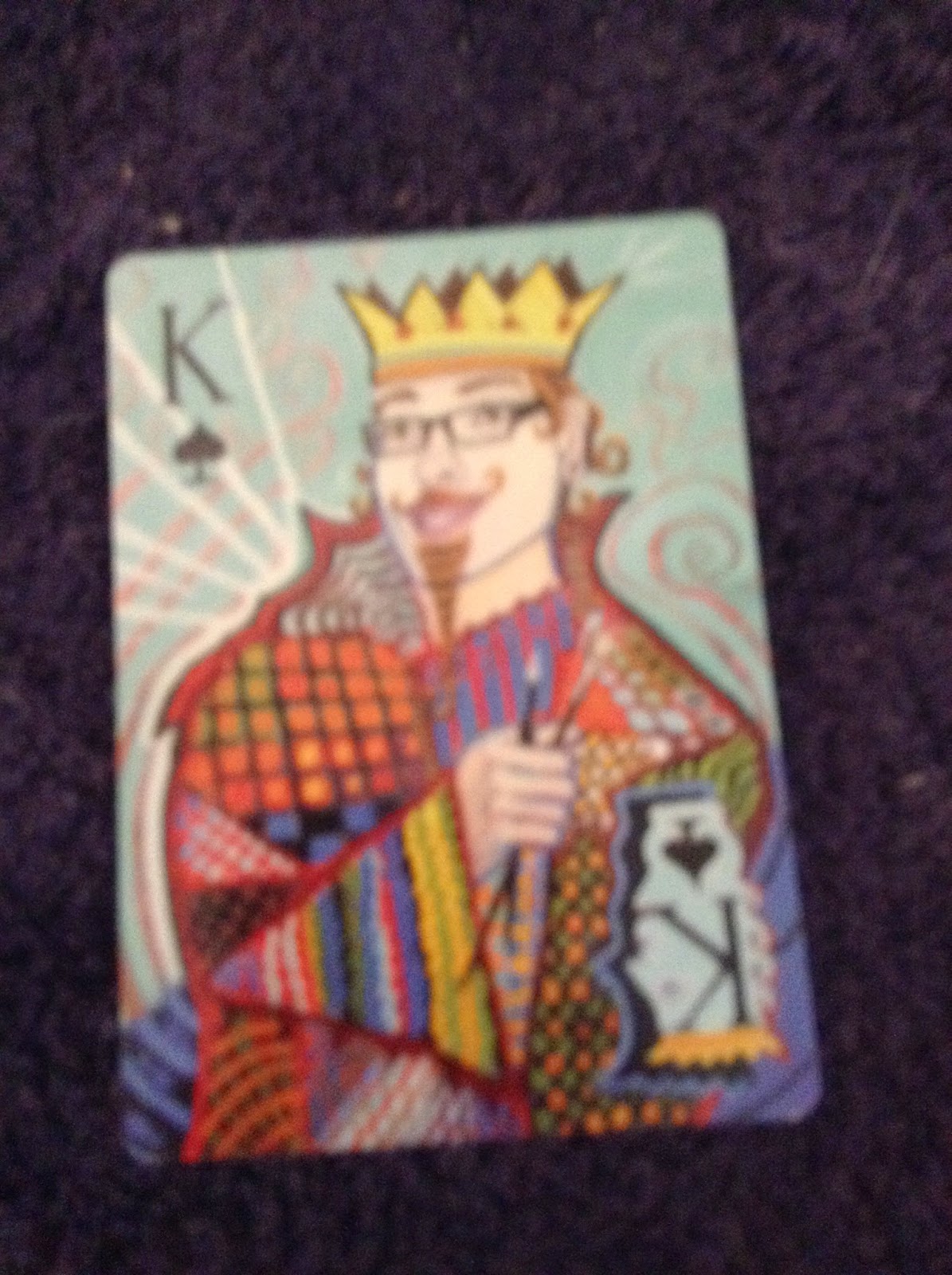
Photo Art is from my playing card collection.

King and queen playing cards are from "Project Portland." Each card was created by a different artist and donated. Cards were sold to benefit non-profits in the Portland Area.

The cowboy picture is from Rodeo Playing cards.

Shop Amazon - Valentine's Day Savings - Fire HD 6 Tablet

Thursday, February 5, 2015

Learning Hack of the Day: Pegging Lists

What do the Lone Ranger, The Three Stooges and Mary Poppins have to do with learning faster, easier, better? Read on.
Numbers are best memorized by using associations. There are numerous (no pun intended) ways for creating a numbers pegging list. You could do it by sound.

1 is a bun

2 is a shoe

3 is a bee

4 is a door

5 is dive

6 is a trick

7 is a heaven

8 is a skate

9 is a sign

shape

1 is a tree;

2 is a swan

3 is Mickey Mouse ears (rotated )

4 is a sailboat

5 is a sea horse

6 is a is a musical note

7 is a gold club

8 is a pair of eye glasses (ratated)

9 is a balloon.

There are other methods. My favorite is by association.

1 is the Lone Ranger

2 is dancers

3 is the Three Stooges.

4 is The Beatles

5 is the Dave Clark Five

6 is Number Six from “Battlestar Galactica” actress Tricia Helfer

7 is “The Magnificent Seven” or just one actor from the series. I use Yule Brenner

8 is Dick Van Patton (“Eight Is Enough”)

9 is a Muse

I don't have to stop at nine. I could continue

10 is the British Prime Minister who lives at Number 10 Downing Street or a ten gallon hat.

11 is George Clooney (“Oceans 11')

12 is Brad Pitt (“Twelve Monkeys)

13 Huck Finn who was 13 years old in the book.

14 Woodrow Wilson for his 14 Points or William Shakespeare for his 14 line sonnets.

15 Bart Starr, Green Bay Packer Hall of Famer who was number 15 Use any sports star you wish.

16 a teen age girl who is blowing out the 16 candles on her birthday cake.

17 Mary Poppins who worked at 17 Cherry Tree Lane.

18 a truck driver

19 a golfer

20 Abe Lincoln (a score is 20 years.)

It is not enough to memorize a pegging list; think briefly about the associations and peg them in your mind.When you need a longer number. Put images in your mind and chain them together.

To memorize pi (3.1415926535), I might think about the three Stooges (3) who are goofing around when along comes William Shakespeare (14) who wants to write a sonnet about the Three Stooges. Imagine these men interacting for awhile. Along comes Bart Starr or any foot ball player (15) who wants to show off tossing the ball or kicking field goals. But his muse (9) is holding him back. She is wearing a red gown and a gold chain and she is struggling to keep Bart Starr from playing football. She says he should be writing his memoirs. Shop Amazon - Valentine's Day Savings - Fire HD 6 Tablet Shop Amazon - Textbook Trade-In - Get Up to 80% Back

Sunday, February 1, 2015

Learning Hack of the Day: Ginkgo Biloba

In “The Dog Who Came in from the Cold,” Dee one of the characters is marketing a vitamin pill to increase ability to do Sudoku puzzles. It’s really Ginkgo Biloba, a popular dietary supplement that increases blood flow to the brain. It does indeed increase mental ability, It helps students too. Ginkgo is available in most grocery stores and pharmacies.
http://www.amazon.com/b/ref=as_li_qf_br_sr_il_tl?_encoding=UTF8&camp=1789&creative=9325&linkCode=as2&node=3760901&tag=leliawhki-20&linkId=I553ELM747WVSLRE

Wednesday, January 28, 2015

Learning Hack of the Day: Have Specific Goals.

A student should have goals for every week, every month, every season. Have a plan. He should have a one year, a five year, a ten year plan. Studies of college graduates showed that those who had definite plans were more successful. The more specific the goals were, the more likely they students were to reach their goals. You can't reach a goal if it is not specific. One student may want to be a business owner someday. A second student may want to be managing a funeral home at the end of one year. Own a funeral home within the next five years and own two or more funeral homes at the end of ten years, (A real example from one of m ex students) The second student has a better chance of obtaining her goals. Even teachers and retirees need to make goals. In 2015, I plan on blogging everyday and taking a workshop class in novel writing. I plan to have my first novel ready for publication by the end of that year. I plan to work on one book a year after that.
Shop Amazon Home - New Year, New You - Take Control of Your Closet Shop Amazon - Textbook Trade-In - Get Up to 80% Back